Showing posts with label Klaus Meine. Show all posts

Thursday, June 7, 2012

Scorpions' Matthias Jabs: When the Smoke is Going Down

The Scorpions are set to embark on the final leg of their last U.S. tour.
Most Scorpions fans would agree, "Blackout" is the band's take-to-a-deserted-island album.

The 1982 release not only truly broke the band in America, but it is pretty much a melodic hard rock masterpiece from start to finish. While "No One Like You" -- and its breakout solo by guitarist Matthias Jabs -- was the defining hit, the album was littered with songs that could have been successful singles. I often wonder how "Can't Live Without You," "You Give Me All I Need" and "Arizona" would have fared on the charts, if only they'd been released.

Despite all the album's air-guitar anthems, however, it is the haunting closing number, "When the Smoke is Going Down," that inevitably stays with me long after the song has ended. I've always been intrigued by the imagery wafting through the seemingly perfect combination of lyrics and music as the song examines the post-show viewpoint from the band perspective.


"Just when you make your way back home
I find some time to be alone
I go to see the place once more
Just like a thousand nights before
I climb the stage again this night
'Cause the place seems still alive
When the smoke is going down."

I've been to enough backstage affairs over the years to know the routine -- with all the aftershow hoopla, greeting of fans and inevitable walk to the buses that will take the band to a new city, where the process will all be repeated again -- and this perspective rings true to me. I get lost in the song, and can totally see band members returning to a mostly empty stage for a moment of quiet solitude, reflecting on the power of the shared experience with fans an hour or two earlier and their different paths of the present. All, quite literally, as the smoke is going down.

"This is the place where I belong
I really love to turn you on
I've got your sound still in my ear
While your traces disappear
I climb the stage again this night
'Cause the place seems still alive
When the smoke is going down."

 It's hard not to see parallels between this song and the current state of the Scorpions, who are beginning the final leg of their final U.S. tour on Friday. (The tour's third stop is Monday at USANA Amphitheatre near Salt Lake City.) With their announced intentions to retire from touring, most likely at the end of this year,  the smoke is metaphorically beginning to swirl around the band's 37-year career.

But with so many memories and so much great music that always will remain only an album, cassette, CD, iPod or YouTube clip away, perhaps the smoke will never completely settle over Scorpions nation -- a place which will always seem still alive.

Here's my latest interview with Jabs, which occurred on May 22, where he called from his home in Germany during a short break from the band's grueling three-year ultimate tour. We only had 10-15 minutes to chat, so there were many topics left uncrossed on my preferred-questions list. But we did have time to discuss an array of subjects, including where the band is at mentally at this stage of the final tour, some of his favorite openings to Scorpions shows over the years, one more studio project that should be intriguing to fans and why he has been so underrated and never received his due in the annals of all-time great lead guitar players.

Oh, and we also touched on "When the Smoke is Going Down" and why he can't resign himself to the tendril mercies of that metaphorical mindset just quite yet.

DOUG FOX: I've got to say, it is such a pleasure to talk with you again.

MATTHIAS JABS: Have we talked before?

DF: We did, we talked two years ago when you came to Salt Lake City.

JABS: OK.

DF: Yeah, we had a great interview. It's been one of my favorite ones.

JABS: Oh, good.

DF: When we talked last, two years ago, you were just at the beginning of this
final victory tour around the world behind "A Sting in the Tail" and this
grand retirement idea that you'd adopted was still kind of fresh and new, I
imagine it still seemed like quite a long ways away to think about it. But
now that you're entering the homestretch and just about to embark on your
last U.S. tour, how is everything standing? How are you holding up, and what
are your thoughts.
 
Klaus Meine, left, and Matthias Jabs making it real in 2010. (Doug Fox)
JABS: Yeah, first of all, it's amazing how time flies. Two years ago and more 
when we started this final tour, this farewell tour, and you know, two years ago
I didn't expect that we would return to the U.S. one more time. It felt like
the last time. But thanks to the demand all around the world, we are playing
certain cities one more time. And that feels great. And we have had a lot of fun
on this final tour. In the beginning, you know, it started out like maybe
I'd expect it -- very mixed emotions, half sad, half OK, not knowing what to
think. But meanwhile I can tell you we've really enjoyed this tour. The fans
are fantastic and the thought is much clearer now. We know that this is
going to be the end, and we're really enjoying the final tour so much that
it's all been worth it. And now I can imagine much better that, you know, 
things will come to an end.
 
DF: Right. Now when we talked before we talked about the song "When the 
Smoke is Going Down," a fantastic song, and how, you know, maybe the smoke 
wasn't quite going down on you guys yet, it was maybe floating around 
and hovering ... but now that you're in that final stretch, can you get yourself 
to that place where the smoke is going down, so to speak?
 
JABS: Yeah, I know what you mean, but you know the difficulty is, when you're
still on the road, the next show is the most important one for our fans.
Like tomorrow, we are flying to Morocco for our very first time -- and last
time -- in Morocco. And to those people, it's the first time they'll ever see
the Scorpions, you know? We cannot, like, tour, generally speaking, with a
feeling, "Oh, the sun is going to set," like we're slowing down or
something. We have to keep it up 100 percent until the very last show and
then we can go, "Oh, OK, last night was the show and that's it now." It's
difficult mentally to think that you are on your final tour while you still
are preparing for every show like you've always done it. I don't know if
that makes any sense, but you have to sort of forget it, forget that you are
on the final tour in order to be in 100 percent shape for the upcoming shows in
order to enjoy them. You don't want to, like, be sentimental. You want to
have fun and have power. And therefore it's like in conflict to a certain
extent and it's better to decide mentally to go, "OK, surprise me. Tell me
when the last show is done." Mentally I can't do that every night to prepare
myself for, you know, this could be the last time in Salt Lake City, or the
last time in lovely whatever. It's like afterward is better than before.
 
DF: Well, I can totally understand that feeling because I think us fans are
experiencing that feeling with this tour because I know when you came to
Salt Lake City on this tour last time, I prepared myself that that was going
to be the last show that I would be able to see you guys. But then to see
that you're coming back, I was just like, "Oh, this is unbelievably great!"
I must say that you guys are really going out on a high note because I've
seen you since way back -- the first time I saw you was on the "Blackout"
tour -- and your show this last time had such energy and was so well-prepared
and everything, as a fan, I could say, "You know, I appreciate what they've
done and this was such a great show that I can accept that it's the last
one." But now, you've got to live up to that again!
 
JABS: Yeah, indeed. Yeah, I understand. You're right, even for the fans it might
be the same twist, so to speak. But I'm glad that we have another chance to
come around because everybody likes to play and perform. We are enjoying it
so much and we are in great shape. Most people say, you know, "Unbelievable,
you guys should continue." But I think our decision is the right one because
now we are in such great shape. Klaus [Meine, vocalist] turns next Friday, like in 
three days from now, he turns 64, and we will continue definitely until the very 
end of this year. If we do anything next year, we don't know yet, I don't think so.
I think the touring will probably end this year. And even though we might
finish a studio project, we don't stop making music, but the typical go on
the road and never stop touring, that will come to an end. And, I think, to
leave the last impression, like what you just said, the show was great, the
band is in good form and you leave the last impression, and the people go, "OK,
they were a great band, good career and everything." And that is the idea
behind staying like this long time on tour.
 
DF: So you may still do other studio projects?
 
JABS: We have one. You know we released "Comeblack," I don't know if you 
know about this ...
 
DF: I do. I have that, yes.
 
JABS: Good. The funny thing was when we announced "A Sting in the Tail" as
the last studio album and the last tour, the record company offered us a
contract for two new studio albums.
 
DF: Oh, OK.
 
JABS: OK, this makes one of them. We also have unreleased stuff, from, 
especially, the early '80s. It was a very creative time for us, you know, starting 
with "Blackout" and "Love at First Sting," and lots of songs which didn't make it
to the albums back then are still great, they're just unfinished. We already
started earlier this year, when we had, like, a certain break from touring. We started 
to listen to everything seeing what's good, what's not good, what's worth updating 
and improving. So this is something we're going to take a serious look at early next 
year in January or February, and I think it's a good thing and the fans will enjoy it. 
It's the sound and the musical ideas from the time when we really got very popular. 
People say the early '80s were our strongest time, anyways. It's a final album for 
the fans with a big thank you for all the support and love all these many years. 
And it's something that could be great.
 
DF: Yeah, I think that could be fantastic. Hey, I also wanted to ask you about
something that's always fascinated me, it's that special moment at the
beginning of the show, you know, when the house lights go out and everything
is dark, and there's a surge of excitement that goes through the crowd. I'm
talking about those moments right after the lights go out, but before the
band starts playing. I know what that moment is like as a member of the
audience, but I was wondering what is that moment like for you personally?
 
JABS: Oh, that is the moment when you definitely know, and the adrenaline flows
and you're just about ready to go on stage, or run up the stairs, because
you're always, like, waiting behind the stage. Then the intro starts, then
that's the moment where you have, like, full concentration. I usually warm
up half an hour before we go on stage, so the fingers are well warmed up.
That's the moment when we hear a click, like a starting click, so that we
all know when to come out of the dark. It's very dark up to the stage.
That's the moment -- and from then on, you forget everything that's
happened before the show. Then for the two hours, I'm within the music and
with the audience. It's a great place to be, on stage, I'm telling you,
because we have so many people around us who keep talking to our ears, you
know, all day. But on stage, there's nobody who can talk to us. And we are
way too loud, we couldn't even hear what they are saying. So that's kind of
cool. It's like you live in your own world.
 
DF: That's what's fun talking to you about that because those of us in the audience, 
we have an idea of what that must be like to be up on stage, but we can never really 
know. That's why I like asking about it. One thing I've thought the Scorpions have 
always done really well is capitalize on that momentum at the beginning of the
show. Over the years, you've had great concert openings. You know, I can think 
back to the "Blackout" and "Love at First Sting" tours where you come running out 
from under the drumset, and you did that different version of "Coming Home" on
the "Face the Heat" tour with Klaus out there sitting on a stool before you
guys came running out ...
 
JABS: Yeah.
 
DF: And I thought you did a fantastic job, like I mentioned a few minutes ago,
with the "Sting in the Tail" opening. How much time do you spend coming up
with those ideas, and do you have a favorite one of the tour openings that
you've done?
 
JABS: I always remember that "Blackout" opening, and it seemed so great with 
the drum riser going up and the Venetian blinds flipping over and the lights
from behind and the smoke.
 
DF: Exactly!
 
JABS: And actually we all liked that so much that we integrated it again into this
show again.
 
DF: Yeah, at "Blackout" again, right?
 
JABS: Yeah, after the drum solo, it's the same visual like [from] the "Blackout"
days. We talk about it all the time, about the new ideas. But to actually do
them, we don't take that long. We have good production people. And we have a
production meeting, say, like two months before the tour, and then
everything gets prepared, and then we usually have very little rehearsals.
The production rehearsals might take, depending on how big the shows, maybe a
week. But I know that some bands are rehearsing and practicing their music
for a show for like four weeks. We've never done this. We do maybe a day.
But it's mostly the technical side that needs to be rehearsed. Or if we do
pyro, which we don't use all the time. Sometimes we do, but the Scorpions,
we're never really like the pyro band like Motley Crue or other bands that
have explosions all night long. The Scorpions don't like it so much, it's
deafening. We don't rehearse that much, but I like that, it's like
spontaneity and the freshness at the beginning of the tour. If you don't
over-rehearse things, then it's more vital, I think.
 
DF: I agree. I've got to say that when it comes to great lead guitar players I
think you've been criminally underrated all these years. I mean, I never see
your name on the lists of guitar greats that they come out with, and I think
that's kind of a travesty. Does that bother you at all, not getting the
recognition in that fashion?
 
JABS: Actually, years and years and years ago, yes it bothered me a little bit.
Never too much because I know what I can do. Sometimes, yeah, I wonder why? 
Is it because we are a German band and we are far away from the [United] States 
most of the time? I don't know what the reasons are. I'm quite happy the way I
am (laughs], therefore I can do without that. But you know, I've never
figured out why it is. I don't know. You tell me. [laughs]
 
DF: Well, you know, I was thinking about it this morning as I was listening to
tapes driving in, getting in the mood for the interview, and it occurred to
me, I wonder if it's because you're in a two-guitar band? A lot of the top
guitarists that are considered and get the notoriety, a lot of them are
from one-guitar bands. And, to me, that shouldn't make a difference, but I wonder
if it does.
 
JABS: The attention is divided, even though I'm very clearly the Scorpions' lead
guitar player. Yeah, maybe it's because of that or because maybe, I don't
know, the Scorpions were changing guitar players. But then again, that can't
be a reason because one guitar player was there for a year and a half,
another, Uli [Roth], for five years, and I'm in the band for 34 years. The career 
basically started when I joined.
 
DF: I agree, I totally agree. My friends and I have talked about that, too, that
are Scorpions fans. You're up there in our top five or 10 guitarists of all
time, and yet we can't even find you on a Rolling Stone list of the top 100. I think 
that's insanity.
 
JABS: I don't know, maybe it's bad management, too. You know, the other guys 
have, like, a better publicist! [laughs]
 
DF: I suppose having 10,000 people a night going crazy over your work helps you
forget about all that?
 
JABS: Oh, absolutely! Yeah, I don't think about it every day.
 
DF: Hey, I just wanted to say, because I'm not sure when they're going to cut
this interview off ...
 
MODERATOR CUTS IN: Actually, I'm sorry to interrupt, but I'm going to 
have to ask you to wrap it up.
 
DF: OK. I just wanted to say that probably one of the most favorite parts of the job 
that I have is getting the opportunity to tell people whose music has had such a
big impact on my life, just to have that opportunity to tell them thank you.
So when I tell you that you're criminally underrated, I really mean that.
Your music and the way you play and the way you approach the instrument and
the concerts and everything -- it's really been like a real charge of energy
and excitement listening to your music for the past 30 years, so I just
wanted to take this chance to tell you thank you.
 
JABS: Yes, thank you. That's very nice.
 
DF: Matthias, thank you so much. It has been a pleasure again.
 
JABS: Yes, thank you.
 
DF: I'll see you in Salt Lake.
 
JABS: See you in Salt Lake!
 
Related content: To read the news story based from this interview, click HERE. To read my 2010 interview with Matthias, click HERE. To read my backstage report from the Scorpions' 2010 concert at USANA Amphitheatre, click HERE.

Like The Editing Room Floor on Facebook: CLICK HERE.


Tuesday, August 24, 2010

'Coast to Coast' with the Scorpions


Backstage with Scorpions lead guitarist Matthias Jabs at USANA Amphitheatre.

 Rock musicians tend to do scores of interviews when they are out on the road promoting a new album and tour, so I never assume that they will specifically remember one they did with me.

That, however, was not the case at the Scorpions’ “Get Your Sting and Blackout” farewell tour at USANA Amphitheatre in West Valley City. The concert may have been the band’s last in Utah – but it provided a first for me.

It’s the only time I can remember being openly mocked eye to eye by a rock star for a question asked in an earlier interview.

I had a 20-minute phone conversation with lead guitarist Matthias Jabs nearly two weeks before we met up backstage prior to the Scorpions’ Aug. 16 Utah date. (You can read the full interview here.) At the end of our earlier chat, I asked Jabs this question: “Of all the interviews that you’ve done over the years and the thousands of questions that you’ve been asked, what’s the one question you wish you would’ve been asked -- but never have been?”

He laughed and said the answer to that question probably doesn’t exist, essentially responding that he’d been asked every imaginable query over the years, and was holding nothing back.

Fair enough.

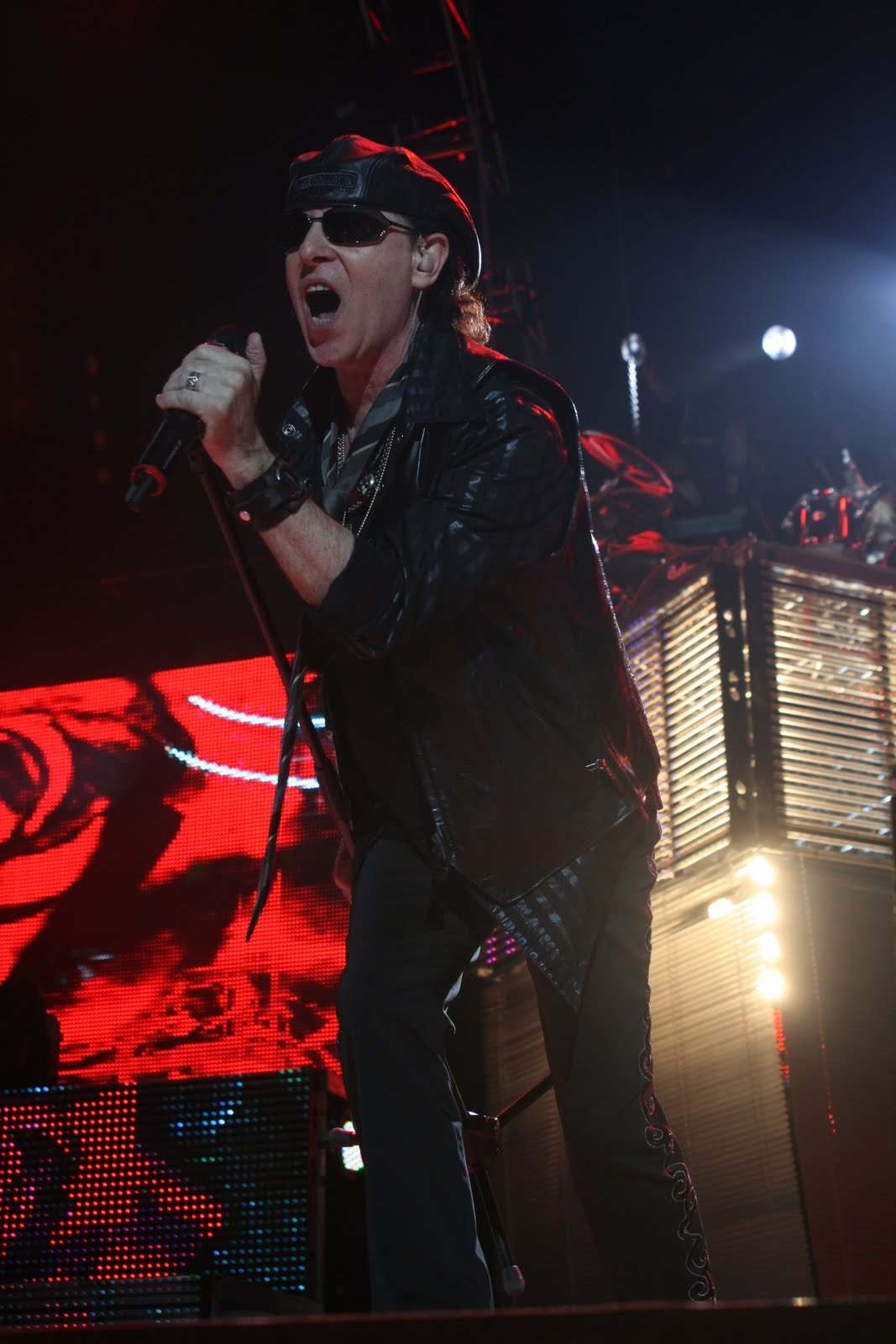
Klaus Meine and Matthias Jabs in concert. (Doug Fox)
On the day of the show, I had the opportunity to meet up with Jabs several hours before he and his bandmates hit the stage with “Sting in the Tail.” We were only a few generalities into our conversation when I asked if there was a certain portion of the band’s live show that had become his favorite part of the night. With a complete deadpan delivery, and tilting his head as if giving the issue serious thought, he responded, “Wow, that is a question I’ve never been asked before.”

Admittedly, I was a little slow on the uptake. My first thought centered on the irony of him answering that to such an innocuous question considering what he’d answered in our original interview. I was still trying to wrap my head around his response when I noticed the slight smile on his face. That’s when I realized he was completely toying with me. I called him on it and we both had a good laugh over it.

I don’t know if Jabs simply remembered the earlier question because he’d never encountered a similar one – or maybe the band’s management had sent him the link to the full interview for him to review before our backstage meeting. Either way, I consider it an honor that it was memorable enough for him to take a good-natured run at me with it a couple weeks later. I mean, it could have been worse. (I’d hate to be remembered, for example, as the person who asked, “If you were a tree, what kind of tree would you be?” during a much-mocked Super Bowl Media Day session.)

One aspect of concerts that’s always intrigued me is how bands develop their setlists. Why, for example, do certain songs seem to stick in the setlist, while other clearly fantastic tunes get dropped after a year or two, never to return? Having seen 13 Scorpions concerts on 10 different tours dating back to 1982, I can tell you that they are always going to play the songs “Blackout” and “Bad Boys Running Wild.” Now, I love those two songs, but neither was what you would consider a hit single. On the flip side, great rocking tunes like “Can’t Live Without You,” “Can’t Get Enough,” “Arizona” and “Wild Child” have all but been banished from the band’s live show. How does that happen?

Rudolf Schenker in concert. (Doug Fox)
One of my all-time favorite songs, however, the melodic instrumental jam “Coast to Coast,” has remained a concert staple. Every new tour, I’m always fearful that this will be the time the Scorps finally drop the tune, off of 1979’s “Lovedrive” album. But it is always there, usually about five to six songs in, serving as a sort of transitory bridge between the first to second third of the show.

I mentioned this to Jabs, pointing out how grateful I was that “Coast to Coast” had managed to stick in the live show all these years.

“It’s like a drum solo,” Jabs said. “We have to play it.”

But not for the reason one might think.

Besides it being a fun song to play every night, Jabs said the main reason it remains is it gives vocalist Klaus Meine a nice break early in the set. The rigors of worldwide touring, sometimes with four to five shows a week, can take a toll on a lead singer, so the band always includes “Coast to Coast” early in the set and a drum solo late as a benefit to Meine.

Klaus Meine belts out a song. (Doug Fox)
We touched on several other topics during a 10-minute chat before Jabs was called away for a scheduled phone interview from South America – where the band will be touring throughout September, before heading back to Europe in October and November. I expressed surprise that the U.S. leg of the tour was over so quickly, but Jabs explained that the band will be returning at some point to the U.S. on this final tour because, “We haven’t played everywhere yet.”

The problem with this being a farewell tour, he said, is that everybody wants you to come right away, so the band is trying to touch all its bases globally before more in-depth return visits.

Three hours after our backstage meeting, the Scorpions launched into “Coast to Coast” on stage, with Jabs and fellow guitarist Rudolf Schenker cranking out the intoxicating rhythm and trading off lead solo breaks. The crowd was fully involved, and experiencing it live – not to mention rib-rattling loud from my vantage point a mere two rows and a photo pit removed from the front speakers -- brought a big smile to my face. At one point early in the song, Jabs meandered over right in front of our location and recognized me in the crowd. He broke out in a huge grin and spontaneously pointed right at me as if to ask, “Yo ... how do you like your ‘Coast to Coast’ now?’ ”

Well done, apparently.

On top of that, I figure Matthias and I are now even – because that’s a question I’ve never been asked before.

Note: For the full concert review of the Scorpions show at USANA Amphitheatre, click here. To see video from the show, click on the following songs: "Loving You Sunday Morning," "Raised on Rock," "Blackout" and "Big City Nights."

Like The Editing Room Floor on Facebook: CLICK HERE.

Thursday, August 12, 2010

Matthias Jabs: Sultan of the Scorpions' Six-String Sting

Date of interview: Aug. 3, 2010


 Matthias Jabs on the "Eye II Eye" tour. (Doug Fox)


Guitar solos are like fingerprints. Every guitarist has some, but they are highly individualized, and mostly unique to each musician’s background and style.

Guitar heroes are all immediately recognized by their signature solos – Jimmy Page in “Stairway to Heaven,” Eric Clapton in “Layla,” “Brian May in “We Will Rock You,” David Gilmour in “Comfortably Numb” and Eddie Van Halen in “Eruption.” Jimi Hendrix made his biggest statement by saluting the “Star-Spangled Banner” in feedback and distortion.

Which is why I was caught completely unaware in 1982 when I first laid ears on the guitar solo in “No One Like You.” I had no idea who this band or lead guitarist was – but what I did know was their record would be joining my collection at the first available opportunity.

That was my introduction to the Scorpions and Explorer-wielder extraordinaire Matthias Jabs.

From its opening salvo featuring a staccato burst of pinched harmonics to its ultimate explosion of melodic jam culminating in a gut-punching A-string slide, Jabs’s 34-second solo in “No One Like You” has no doubt made millions of females weak in the knees and forced as many guys into fits of air guitar fury during concerts around the world over the years.

Whether flashy (think “Rock You Like a Hurricane”) or understated (see “Your Last Song” on “Humanity: Hour 1”), Jabs’s solos not only fit the song, but they also lift it – and actually take you someplace.

In our interview, Jabs (calling from a concert stop in Las Vegas, Nev.) talks about the Scorpions’ farewell tour in support of “Sting in the Tail,” his use of the talkbox to enhance the atmosphere of certain songs, the melodic nature of his playing, why he doesn’t have many songwriting credits with the Scorpions and what happened with his iconic black-and-yellow-striped stage outfit from the mid-1980s.

However, since my indelible introduction to the Scorpions came with Jabs’s solo in “No One Like You” – that seemed like a good place to start our discussion.

Doug Fox: I’ve been a Scorpions fan for nearly 30 years and I can trace that back to one specific event -- the very first time I heard the guitar solo in “No One Like You.”

Matthias Jabs: Yeah?

DF: It’s one of the few guitar solos that I can remember exactly where I was when I first heard it. After hearing that, I said, “I’ve got to go out and get this album from a band I haven’t heard of before.” That was one of the band’s breakout hits in the U.S., but, to me, your solo really makes the song.

Jabs: Yeah, that’s nice to know. Actually, I heard, like, radio commercials for our shows that just had the intro, and not even vocals in there. So obviously, that’s already good enough to promote the show, or that song, or that album or whatever. So, that’s nice. Yeah, 30 years later, here we are.

DF: I was wondering if you could tell me about the creation of that solo – was it something you worked a lot on to get everything just how you wanted or was it more spontaneous and in the moment?

Jabs: No, it was like ... you know, in a good song, there’s more than one melody and usually the better the song, the easier it is to find the right additional melodies for it, and somehow that melody is well hidden in the chorus melody of the vocal, and I just developed it. But I worked out one. And when I had the main melody with all the phrasing, then I worked on the harmonies, too. But it was inspiring to begin with, you know, when I heard the song the first time. It had a working title back then, I think it was “Talk About You” or something, you know, before it was called “No One Like You,” and already, I said instantly, “Guys, I think we’ve got something here,” and when you have that feeling, then you put extra effort in to find the right components. And so with this one I knew it’s worth working out the guitar parts like they are today until they are really convincing.

DF: I’ve got to say that from the first note to that nasty slide you do at the end -- it’s, like, pure perfection.

Jabs: Can you play it?

DF: No, I play a little bit -- but I would like to.

Jabs: Yeah.

DF: Well, you have been in the United States for several weeks now, how are the fans reacting to this, your final tour?
                

Jabs: Excellent. I mean, we started out on the East Coast in the middle of June, and, traditionally, we were always stronger in the Southwest, where we are now, or all of the West Coast and, like, up to Chicago, but this time, with a fantastic reaction and lots and lots of people in New Jersey and Philadelphia and wherever, New York even. So it’s been like this on the whole tour now, great reactions from the fans, great shows and lots of people. So we are very happy with this, especially when we hear, “Oh, there’s a crisis and many bands have to cancel” or, “Shows are not doing so well.” But with us, I’m sure it helps when we say it’s the farewell tour. But we are getting people convinced to come out and see us one last time. It works well. It’s great fun, and we don’t think about, like, that it’s the last time every night. We just enjoy it so much that it seems like it’s normal [just] the beginning of a long tour, which is actually true. But the thought which we were afraid we would have every night, “Oh, bye-bye [said in melodramatic voice],” you know, that doesn’t really fly at the moment. It’s too much fun.

DF: I’ve got to say, as far as your manager [Peter Amend], you know, I’ve read how he brought up the idea to retire with this album and tour to you guys -- I’m not quite sure if I should love this guy or hate him!

Jabs: I was never sure about that either [laughs] -- even before he came up with the idea. I mean, it makes sense. There’s a certain logic to it as well. He argued, like, “OK, you have a strong album,” when he heard, you know, not the final mixes, but it came up when we played the music to him at the record company over in Europe, and everybody was so excited, “Oh, great new album!” And he came back a couple days later and [said] “The album is great. If you now go on the road ... ” and the previous tour took us like two and a half years around the world. He said, “This will be the same, two and a half, maybe three years, but if you call it the last tour and the last album, it will be exciting. It will be hard to top anyway in three, four years from now.” He said, “Do the math. You know, Klaus and Rudolf are already 62 years old, so by the time we are done with this whole tour, they’re like close to 65. Then you take a break, you start writing songs, you go back to the studio, the old routine. By the time it comes out, they’re 67 or something. And by the time that this tour would be over, they would be, like, close to 70.” And you wonder if it makes so much sense to sing ‘Bad Boys Running Wild’ when you are close to 70. I mean, at the moment, I must say nobody looks 62. And we are well fit and in great shape. Touring is like a workout program anyway, so we are getting more and more in good shape. So at the moment, everything is fine. And the idea was, OK, let’s leave a last impression to the fans that the Scorpions were already a great live band and we don’t want to limp around one day being close to 70 and create some kind of an embarrassment. Because sometimes some bands, I must say without mentioning any names, but some bands, they should have stopped some time ago. You know what I mean?

DF: Yes. Well, I’ve got to give your manager credit, because as you mentioned in talking about your shows in the U.S. so far, I think it has created a lot of momentum for you guys in being able to get a lot of people interested in seeing the band again.

Jabs: Yes.

DF: There are so many good songs on the new album -- which ones are you having the most fun playing live?

Jabs: We play, at the moment, three or four. You know, we change the setlist around a little bit once in a while to keep it interesting. But the four songs we play live are the title track, “Sting in the Tail,” that’s the opening song and always will be for this leg, and we also play “Raised on Rock,” the first single on the album, which goes down very well. And we play sometimes “The Good Die Young,” which is [Track] No. 4, and sometimes we don’t. And then, what has surprised me, the last song, “The Best is Yet to Come,” which I assume if we have, let’s say, 10,000 people in the audience that maybe -- it’s my guess, what do I know? -- but maybe 500 to a thousand have bought the new album at the most. The others could come from, like, “Yeah, I’ve been coming to the Scorpions since ... ” but everybody is singing it. So I’m thinking, and nobody plays it on the radio, but it’s amazing how everybody is singing that song, “The Best is Yet to Come.” You will see. So we play those four new tracks and they blend in very well with, like, anything from the ’80s or ’90s, so that’s all very good.

DF: Now, “Raised on Rock,” that you mentioned, has some great talkbox on it that really adds to the song. I’ve really liked your use of the talkbox over the years, you kind of sprinkle it on songs here and there, but never to the point where it feels overused or kind of becomes a gimmick. But I’m wondering, where did your love of the talkbox come from?

Jabs: I played if for the first time in late 1979 when we recorded “Animal Magnetism” for the song “The Zoo.” Because “The Zoo,” it talks about that creepy 42nd Street in New York, back then, now they’ve cleaned it up. We don’t even recognize it anymore because we looked for it when we were in New York just a couple weeks ago. And so, this song had, like, this creepy atmosphere, and to enhance this, to add something to it, because it was all the drug dealers, and all that, you know, sleazy, creepy feel in clubs and
whatever. “What can I do,” was the thought, “to enhance this musically?” And so the talkbox came to my mind. It was the first time I ever played it. And so I added just touches to it. Later on in the live version of “The Zoo,” like on “World Wide Live” or the way we still play it today, it’s an extended solo, but back then it was just there to enhance this atmosphere. And then, meanwhile, I used it in a couple songs, you know, not every album, if we played that would be like, “Ewwwwww,” But wherever it’s right, and on the new album we’ve found, like, for two songs it’s right -- “Raised on Rock” and “Slave Me,” there’s also talkbox in there -- and I just play in “Slave Me,” like the chorus riff with a talkbox as well. It adds a certain atmosphere, which I always like.

DF: That’s interesting to me that you had never played it before you played it on “The Zoo.” I assumed that you had probably had a lot of experience with it before then.

Jabs: You know, the thing with the talkbox is you cannot just set it up at home and play with it. It works in a way ... I have different ways of doing it today, but basically you need an amp and you need a speaker cabinet or the talkbox, which is something like a speaker. Therefore, you need to set it up, and it’s very loud. Even without amplification, the talkbox is so loud that, you know, if you don’t live on a ranch by yourself in the desert, the neighbors will come [complain]. It’s nothing to really rehearse at home.

DF: All right, interesting. Now, when you joined the Scorpions, of course, they were already a somewhat established band, but to me, what you really brought was great melodicism as a lead guitarist. No matter how hard rocking the rhythm of a song may be, whether it’s like “Rock You Like a Hurricane” or “Dynamite” your lead playing is so melodic that it totally ties everything together and makes it really accessible. It’s no coincidence that the band’s biggest hits started after the time you joined. Where does the melodic nature of your playing come from?

Jabs: I had it already, like, in the local bands I played before the Scorpions. There’s even one recording on a 45 vinyl and what you hear is a melodic in harmony-played guitar melody. You know, I brought this style to the Scorpions, I had it already before. Wherever it comes from, I don’t know. It’s what I like. And as I mentioned before with “No One Like You,” for me, guitar playing is, OK, it’s fun to be a bit flashy once in a while, but mainly, guitar playing to me is making music. And therefore, I play, like, what I feel is the best for the song. And even in a guitar solo, I think the song should continue, and not just, like, “Here’s a break.” And how radio treats guitar solos many times, “Here, just cut it out” because it’s some guitar player playing something. But if the song continues because of the guitar playing, then it’s even much better. And that’s how I treat it.

DF: Yes, it really comes across. I think it’s part of the band’s signature sound that way.

Jabs: Yeah, I mean, when I joined, I think for the first time the Scorpions felt like we were a unit, you know, a real band. And before, they made interesting music, but it was always two different styles within one band. Because of the previous guitar player, Uli [Jon Roth], who was so Hendrix-oriented that you could tell, “Here’s an Uli song, and there’s a Klaus and Rudolf song. So, you know, everybody admits that was a difficult time and it was two different styles at once, and as soon as I joined we sounded, yeah, like a unit.

DF: It’s interesting you mention the Klaus and Rudolf songs, because here’s something I’ve wondered over the years. Obviously, there’s no question that your playing has made the band more of a unit and has developed that sound, but I look over the writing credits in the Scorpions’ catalog, I don’t see very many from you, especially as many as somebody might expect for somebody who has such an impact ...

Jabs: You know, it is about how the band, or the other writers see it. Unfortunately, I must say, within Scorpions, it’s like all the stuff I add, for example, they consider as arrangements -- while in other bands, I know that the people go, “OK, whoever contributes something gets a share as a writer.” So, like, Van Halen used to do that in the beginning. It was always like four guys, always equal. Because all four do whatever they do. And when I joined, which is a long time ago, it was already established that whoever has the main, basic idea is the songwriter, and everything else is arrangement. So, there’s nothing you can do.

DF: So, you’re definitely writing a lot, it’s just not showing up that way.

Jabs: Absolutely.

DF: Another thing I thought you brought to the Scorpions was one of rock’s iconic stage outfits -- the one with the matching yellow-and black-striped pants and arm bands.

Jabs: Yeah.

DF: It’s too bad Stryper had to copy that.

Jabs: Exactly! I mean, as soon as I saw the Stryper album cover, everything striped in yellow and black, I took the stuff off and never used it again [laughs]. How original can a band be [laughs]?

DF: I was wondering, where did that outfit end up?

Jabs: Actually, that’s a good question. I think I donated it to some charity, which we did a lot in the ’80s, and I wasn’t really thinking about stuff, like, the Rock and Roll Hall of Fame in Cleveland, where they’re asking for it. I donated -- not donated, I loaned -- the guitar, my first Explorer, the one I played “No One Like You” and “Rock You Like a Hurricane” ...

DF: The Explorer 90?

Jabs: No, the one before, the first one, which I played “No One Like You,” for example, or “Rock You Like a Hurricane” or “Still Loving You,” all the early ’80s stuff -- that’s one in the original size. Ninety stands for 90 percent of the size, which I came up with later. But it’s at the moment in Cleveland and they want to display it, but they also wanted to have the black-and-yellow-striped pants, and I went, “OK, I’m not at home so I don’t know where to look for it at the moment because I’m on tour.” But I’m afraid I’ve given it away already.

DF: Can you imagine the reaction if you broke those out on a few dates of this last tour?

Jabs: I know! But, secretly, I wear black pants with tiny little yellow thingies here and there. It’s a hint, a micro-hint thought of it, but not in the same way.

DF: One of my favorite songs has always been “When the Smoke is Going Down” ...

Jabs: Yeah.

DF: It’s got such great imagery to it, what’s captured in the lyrics. I’m wondering, now that the smoke is kind of going down on the history of the band, does that song take on any added meaning for you guys?

Jabs: Um, no, not in that sense. We used to play it in recent years, on the last tour, for example, we used to play it as an additional song, like, after the last encore. We came out one more time, like the lyrics in the song describe, but with the audience still in there. It’s about, you know, everybody has left the place and then the vibe and everything is still in the building, but we played it as the very last song. And usually the towel wrapped around the neck, like, you know, if you come back from the dressing room -- and that went down very well. It’s a nice song to play live. Yeah, you wonder. We are not playing it at the moment, and I don’t know if the smoke is already coming down, it still feels like we are at the beginning of the last adventure, but I know exactly what you mean.

DF: So the smoke is floating around waiting ...

Jabs: Yes, it’s still floating [laughs].

DF: Hey, do you have any specific memories of concerts that you’ve had in Utah?

Jabs: Yeah, I mean, I remember, I guess, almost all of the shows we’ve played in Salt Lake City. We’ve been there quite a few times, though, over the years -- but I don’t think we have played that amphitheater [USANA Amphitheatre] where we play this time.

DF: You have not, that’s correct.

Jabs: Is it new?

DF: It’s new for ...

Jabs: For the Olympics maybe?

DF: No, it came after the Olympics.

Jabs: OK.

DF: I’m trying to remember ... the last time you came here was on the “Unbreakable” tour, and you played at the E Center, which was made for the Olympics.

Jabs: Yes, OK.

DF: And this was built after that time.

Jabs: OK, is it a nice one?

DF: Yeah, yeah.

Jabs: Good. Great.

DF: As guitar players, you and Rudolf have really carved out the sound the Scorpions are known for. How do your styles of playing differ and how do they complement each other?

Matthias Jabs and Rudolf Schenker "Face the Heat" in 1994. (Robb Hicken)
Below, Schenker on the "Unbreakable" tour in 2004. (Doug Fox)

Jabs: We really are different as guitar players, which makes it easier to work together, because it’s basically decided up front who plays what. That makes it easier. Rudolf likes playing the rhythms, even though I play the rhythms as well, I can tell you for the last two albums, I laid down all the rhythm guitars first. So everybody knows exactly how it goes, how the groove is meant to be and how, in case somebody, like a producer, wants to edit something, then he has, like, an editing reference. So, like I said, it’s for a few years that I’ve even put down the rhythms first, but then we work on the overall guitar arrangement and sometimes, it’s, like, if you, on the new album, for example, go to “Lorelei,” it’s one of those ballads, if you listen carefully, there’s like so many different guitars that blend into each other. I used, I think, at least eight different guitars, including the acoustics, so stuff like that, it takes a little bit of time to work it all out and make it sound nice. That’s not the typical song where you go, OK, like in the title song, I put down the rhythm and 10 minutes later, “OK, guys, this is how we do it.” You know, that’s an easy one to play. But, you know, some of the songs, they really need an arrangement, a guitar arrangement. But to your question, basically Rudolf doesn’t play lead at all, I would say, lately. And he played it in a few songs, usually the
ballads, never in fast songs, so that’s why it’s, like, decided. Over the many years we know who has his strengths where and for what type of song, so it makes it easy. Different than, I guess, if we have a band where both guitar players are, like, equal in what they do, then they have to probably find out, “OK, your idea is better than mine, that’s why you play this.” So we don’t have that that much.

DF: Of all the interviews that you’ve done over the years and the thousands of questions that you’ve been asked, what’s the one question you wish you would’ve been asked -- but never have been?

Jabs: Oh ... I don’t think that exists! [laughs] If so, I couldn’t think of any -- or I would have thought about it much earlier. I don’t think there is a question which hasn’t been asked. Maybe you’ve surprised me now! [laughs]

DF: Maybe this is it?

Jabs: Yes, this is probably it.

DF: There’s not something you’ve always wanted to talk about, but nobody’s asked you about it?

Jabs: No, I mean, I could just start talking about it -- if I really had the desire to talk about something.

To read my post-concert post, including details of a backstage meetup with Jabs, click here.

Read the story based on this interview.

Like The Editing Room Floor on Facebook: CLICK HERE.